
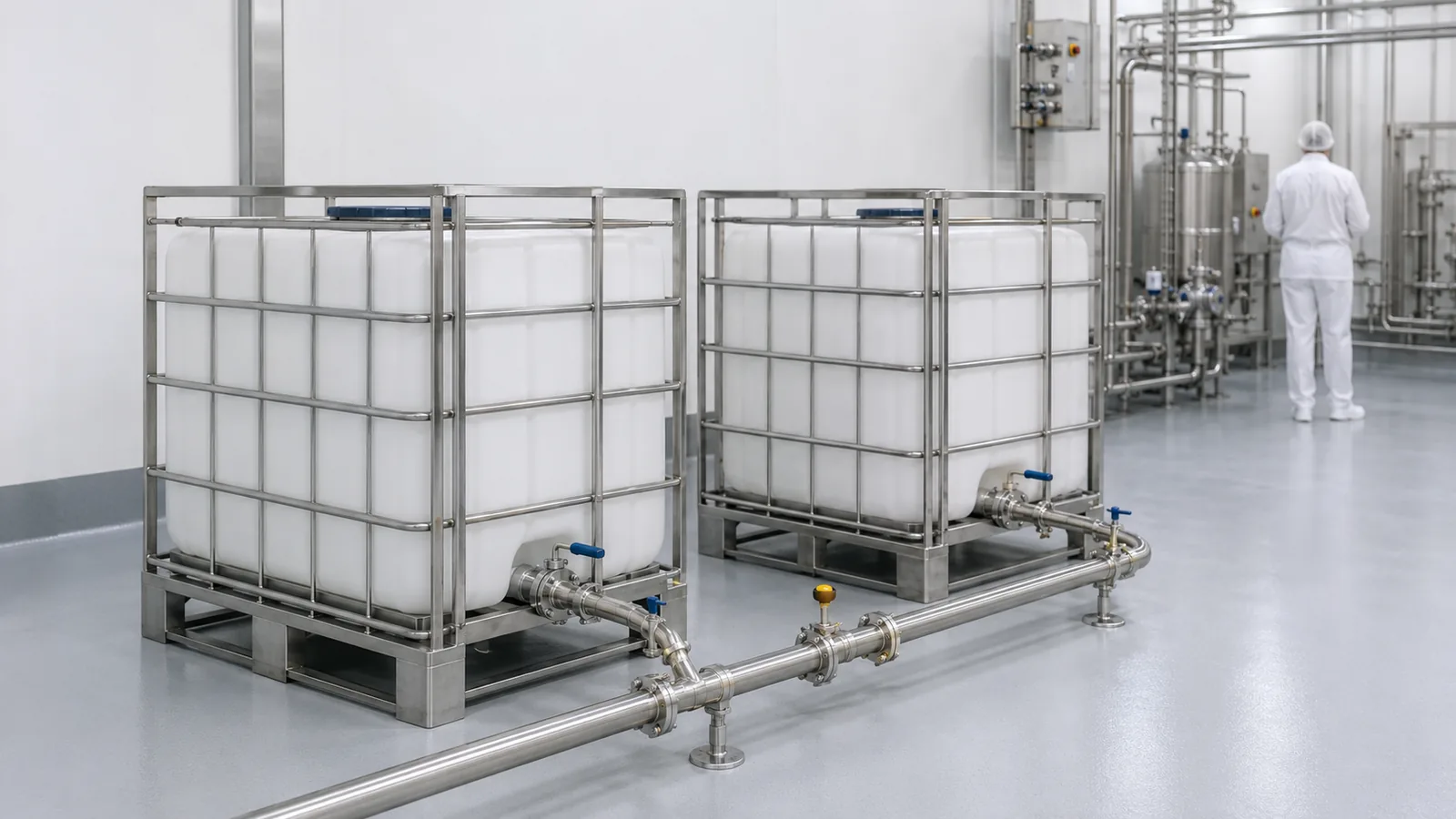
For edible oil and other foodstuffs you need an IBC with a new or rebottled food-grade inner bottle, backed by a Declaration of Compliance under Regulation (EC) No 1935/2004 and Regulation (EU) No 10/2011 — a washed used IBC is not enough. What you do not need is UN certification: edible oil is not dangerous goods, so “without UN” is the normal (and cheaper) choice for a food-grade IBC.
This is what a complete enquiry looks like in practice:
One sentence, seven attributes — and any supplier can price it straight away. This page explains what sits behind each of these attributes and how to put together your own specification.
What “food-grade” really means for an IBC
Food-grade is not a marketing claim but a documented legal status. The basis is three EU regulations: Regulation (EC) No 1935/2004 (the framework regulation for food contact materials, Article 3: no release of substances hazardous to health), Regulation (EU) No 10/2011 (the plastics regulation with migration limits — decisive for the HDPE inner bottle) and Regulation (EC) No 2023/2006 (good manufacturing practice/GMP in production).
The proof is the Declaration of Compliance under Article 15 and Annex IV of Regulation (EU) No 10/2011. In B2B sales of plastic food contact material it is mandatory — request it with the quotation, not only with the delivery. Check two points in it: it must cover the product-contact plastic parts (inner bottle, plus lid and valve body where applicable — not just “the IBC”), and it must include fatty foods. Migration testing is carried out with food simulants; for oils and fats, simulant D2 (vegetable oil) is the relevant one. A declaration that only covers aqueous fillings is of no use to you for edible oil.
Important: the elastomer gasket is not covered by Regulation (EU) No 10/2011 (which applies to plastics only — rubber is excluded in Article 2). Its food-contact compliance runs via the framework Regulation (EC) No 1935/2004, in Germany typically evidenced by BfR Recommendation XXI (BfR: German Federal Institute for Risk Assessment). In practice this means: get the suitability of all product-contact parts confirmed in writing.
And the point where most procurement projects go wrong: the Declaration of Compliance proves a material property — it says nothing about the container’s history. An IBC that once held chemicals does not become a food container again by being washed; HDPE absorbs substances, and residual migration remains. You are only food-grade with an inner bottle that has no history.
New or rebottled — the only two options
- New (factory-new): inner bottle, cage, pallet and valve all unused. Maximum assurance, full documentation from the factory.
- Rebottled (new food-grade inner bottle in a used cage): a factory-new original inner bottle is fitted into a cleaned, inspected used cage and pallet. The product contact is as-new — the cage and pallet never touch the medium. Equivalent for food use, around 20–25% cheaper.
What is not enough: a washed or “reconditioned” IBC with a cleaned old bottle. Even professional cleaning does not turn a used inner bottle into a food-grade one — no reputable reconditioner will issue a Declaration of Compliance for it. Watch out for the term “reconditioned”: dealers use it inconsistently, sometimes for a new bottle (rebottled), sometimes for a washed old bottle. Always ask specifically: new inner bottle or cleaned old bottle?
The specification checklist for your enquiry
With these eight details your enquiry is complete — any supplier can quote price, lead time and MOQ directly:
| Attribute | Typical wording | What matters |
|---|---|---|
| Volume | 1,000 L (alternatives: 600/640, 800, 1,250 L) | 1,000 L is the standard with the best availability and the best price per litre |
| Inner bottle | “new food-grade inner bottle” or “rebottled food-grade” | Request the Declaration of Compliance under Regulation (EU) No 10/2011 with it, including fatty foods |
| Pallet | plastic pallet (instead of wood) | Hygiene: washable, no moisture uptake, no mould, no splinters — standard in HACCP environments. Surcharge ~ EUR 15 |
| Cage | new or inspected used | Does not touch the medium; “new cage” = appearance plus full stacking capability |
| Filling opening | DN 150 or DN 225, open/closed | DN 225 for viscous media and fast filling; “closed” = lid without a degassing vent (usual for oil) |
| Outlet valve | fixed 2-inch outlet valve (DN 50), ball or butterfly valve, S60x6 | 2-inch is standard; state the connection thread for your filling line |
| Gasket | PCP, EPDM or Viton/FKM | Must match the medium — see below |
| UN certification | for food: without UN | UN = dangerous goods transport, not hygiene; “without UN” saves ~ EUR 20–30 per container |
Which gasket for oils and fats?
The standard gasket in a water IBC is EPDM — and that is exactly the wrong one for edible oil: EPDM swells on contact with oils and fats. For edible oil, the PCP gasket (polychloroprene) in a food-compliant version is the usual choice. For high-fat, hot-filled or aroma-intensive media, have the supplier confirm or offer Viton/FKM — the most resistant option with fats. Important: the gasket is a product-contact part — but its food-contact suitability runs not via Regulation (EU) No 10/2011 but via Regulation (EC) No 1935/2004 (in practice: BfR Recommendation XXI). Have it confirmed separately in writing.
“Without UN” — why that is perfectly fine for food
UN certification (design-type approval under ADR chapter 6.5) is purely a dangerous goods transport property — it has nothing to do with hygiene. Edible oil, syrup or juice are not dangerous goods, so you need no UN approval for transport or storage. Ordering “without UN” saves real money (the UN version costs ~ EUR 20–30 extra) and spares you the ADR inspection intervals that apply to dangerous goods only — such as the five-year limit for plastic inner receptacles under ADR 4.1.1.15. And the reverse is also true: a UN IBC is not automatically food-grade. UN and food-grade are two separate properties.
Need food-grade IBCs — one-off or with recurring demand? Send us your specification and we will match it with suitable manufacturers and dealers.
Send specificationMOQ, lead time, price — the guide figures for your quotation
- Price new, food-grade: ~ EUR 280–320 per unit; the UN version sits at the upper end.
- Price rebottled, food-grade: ~ EUR 230 per unit — the value-for-money standard for food use.
- Minimum order quantity (MOQ): dealers often deliver from 1 unit ex stock; volume discounts start at 2–10 units depending on the dealer, with significant discounts from a part or full truckload (approx. 30–60 units). Manufacturers selling direct often only quote from a full truckload upwards.
- Lead time: stock goods 3–7 working days by freight forwarder. Configured goods (DN 225 lid, PCP or Viton gasket, plastic pallet in your chosen combination) more like 2–4 weeks.
- Recurring demand? Say so. Bottlers with monthly or quarterly demand get different terms than one-off buyers.
All figures are guide prices, as of 2026, for 1,000 L, excluding freight.
Which industries this applies to
The same specification logic applies wherever liquid or viscous foodstuffs are moved in 1,000 L containers: edible-oil bottlers (rapeseed, sunflower, frying oil), syrups and sugar solutions (here the DN 225 filling opening pays off because of the viscosity), juices and concentrates, flavourings (aroma-tight, closed version) and food additives such as glucose, sorbitol or citric acid solution. The differences almost always come down to gasket material and opening size — the rest of the checklist stays the same.
Frequently asked questions
Is a used, cleaned IBC suitable for edible oil?
This is strongly advised against — in practice it is simply not workable: no reputable reconditioner will issue a Declaration of Compliance for a cleaned old inner bottle, and the container’s history can never be fully verified. For food, there are effectively only two acceptable states: factory-new, or rebottled with a new food-grade inner bottle. In case of doubt, your supplier and an accredited testing laboratory settle this bindingly.
Do I need UN approval for edible oil?
No. The UN code is a dangerous goods transport approval under ADR and has nothing to do with food hygiene. Edible oil is not dangerous goods — “without UN” is correct, saves ~ EUR 20–30 per container and spares you the ADR inspection intervals.
Which gasket for edible oil — PCP, EPDM or Viton?
Not EPDM: it swells on contact with oils and fats. The usual choice for edible oil is the PCP gasket (polychloroprene) in a food-compliant version; for high-fat or hot-filled media, Viton/FKM is the most resistant choice — have the supplier confirm its suitability.
What must the Declaration of Compliance state?
For the plastic parts (inner bottle, plus lid and valve body where applicable): reference to Regulation (EC) No 1935/2004 and Regulation (EU) No 10/2011 including the intended use — for oils and fats, that means fatty foods (migration testing with simulant D2). The elastomer gasket is not covered by Regulation (EU) No 10/2011; its suitability is demonstrated under Regulation (EC) No 1935/2004 (in Germany typically: BfR Recommendation XXI). Request both together with the quotation.
What does a food-grade 1,000 L IBC cost?
Guide price, as of 2026: new with food-grade inner bottle ~ EUR 280–320, rebottled (new food-grade inner bottle in an inspected used cage) ~ EUR 230 — each per unit, plus freight. Volume discounts from 2–10 units depending on the dealer, significant discounts from a full truckload.
Why a plastic pallet instead of a wooden pallet?
Hygiene: plastic is washable, absorbs no moisture, does not go mouldy and does not splinter — which is why it is standard in HACCP environments and welcomed in most food audits. The surcharge over wood is around EUR 15.
Is your specification ready? Then send it to us — volume, inner bottle, UN yes/no, pallet, filling opening, outlet valve, gasket, quantity. We will match it with suitable suppliers, and you will receive quotes with price, lead time and MOQ.
Request a quoteAs of July 2026. Legal bases: Regulation (EC) No 1935/2004, Regulation (EU) No 10/2011 (incl. Article 15/Annex IV), Regulation (EC) No 2023/2006, BfR Recommendation XXI; ADR chapter 6.5 / 4.1.1.15 (dangerous goods only). All prices are non-binding guide prices. This is not legal advice — the supplier’s Declaration of Compliance and, in case of doubt, an accredited testing laboratory are authoritative.